WHAT IS ORGANIZATIONAL BEHAVIOR MANAGEMENT (OBM)?

OBM is what happens when you take the science of behavior and use it to solve problems inside organizations, or to change the organization itself. Same principles, different context.
50+
YEARS OF RESEARCH
JOBM
PEER-REVIEWED JOURNAL
ANY
INDUSTRY & SETTING

OBM, DEFINED

Organizational Behavior Management is the application of behavior analysis principles (the same science behind ABA) to improve individual and group performance in organizational settings.
FROM THE LITERATURE
"Organizational Behavior Management is a subdiscipline of Applied Behavior Analysis that addresses a broad range of challenges facing individuals and organizations through a scientific approach to understanding and improving human performance."

— Journal of Organizational Behavior Management (JOBM), Taylor & Francis

If we break that down a bit, OBM practitioners use behavioral assessment, measurement, and intervention. All of those pieces work together to change the conditions that drive performance in workplaces, systems, and organizations. The targets aren't individual clients, like in clinical ABA, they're the antecedents, behaviors, and consequences that shape how teams, departments, and entire organizations function.

The field emerged in the 1970s alongside the broader behavioral science movement and has since developed its own peer-reviewed journal (Journal of Organizational Behavior Management, or JOBM for short), professional network (the OBM Network), and a growing body of applied research across industries from healthcare and manufacturing to education and finance, and more.
Empty space, drag to resize

HOW OBM ACTUALLY WORKS

OBM draws on the same theoretical foundations as ABA. Think things like: 
  • Operant conditioning
  • Reinforcement
  • Three- and four-term contingencies
  • Measurement & visualization
  • Prediction, verification & control
But, OBM applies to problems in the workplace, and at the organizational and process levels. 

The core three-term contingency framework BCBAs already know and love (A-B-C: antecedent, behavior, consequence) is one of the core "workhorses" of OBM.

Where OBM diverges from general management approaches is its love (and insistence) on objective data measurement. Interventions aren't based on intuition or trend (read more about OBM vs. IO psychology here). Instead, OBM practitioners focus on whether they're based on things that can be observed, and then quantified. That helps us deeply understand  what's happening in the system and what's driving it. Some key methods used in OBM are:

PERFORMANCE ANALYSIS

Tools and techniques like the Performance Diagnostic Checklist (PDC; Austin, 2000) help identify the diagnose the reason for gaps between current and desired performance.

BEHAVIOR ASSESSMENT TOOLS

PIC/NIC (Daniels & Darnell, 2017), E-TIP (Braksick, 2000), and others, are structured methods for understanding what's reinforcing (or punishing) behavior in the workplace. 

DATA-DRIVEN INTERVENTION

No matter the target behavior, OBM designs, implements and evaluates the efficacy of its interventions through data collection and visualization; making changes based on trend, variability and other patterns over time. 

FEEDBACL & REINFORCEMENT

Tools and techniques like the Performance Diagnostic Checklist (PDC; Austin, 2000) help identify the diagnose the reason for gaps between current and desired performance.

BEHAVIOR ASSESSMENT TOOLS

PIC/NIC (Daniels, *),E-TIP (Braksick, *), and others, are structured methods for understanding what's reinforcing (or punishing) behavior in the workplace. 

DATA-DRIVEN INTERVENTION

No matter the target behavior, OBM designs, implements and evaluates the efficacy of its interventions through data collection and visualization; making changes based on trend, variability and other patterns over time. 

OBM VS. OTHER APPROACHES

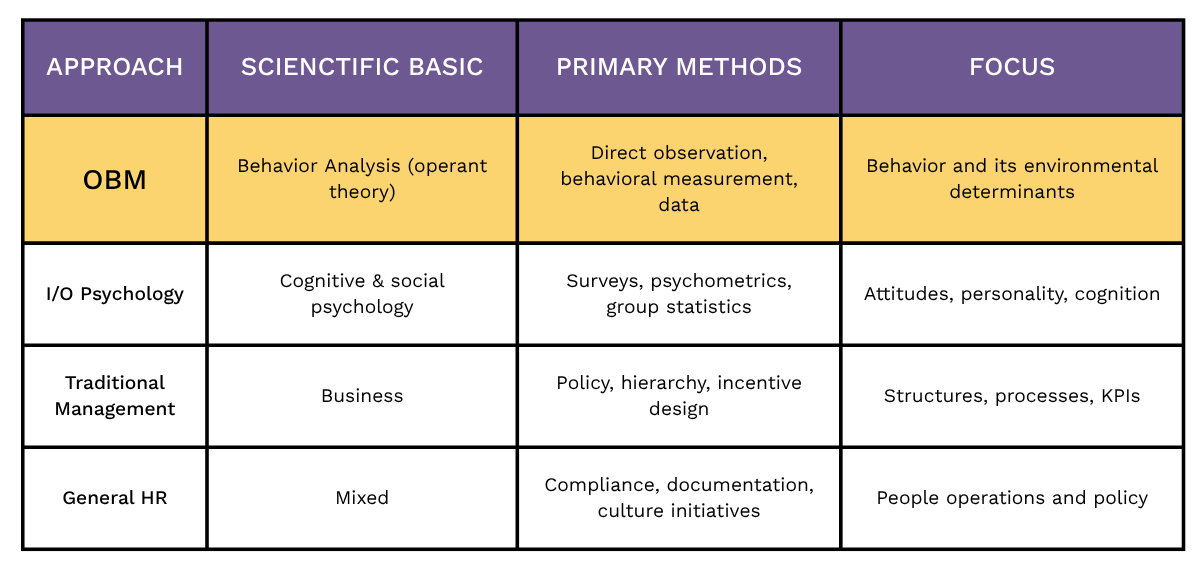
OBM is often confused with I/O Psychology, management consulting, or general HR work. That confusion makes sense, because there is overlap is a lot of the things these approaches help improve. 

Without getting too into the weeds, here are some of the core differences between the approaches:
The OBM advantage? It's the only approach that treats human behavior in organizations as a scientific phenomenon. That is, OBM treats workplace problems like problems that can be measured, analyzed, and changed systematically. Gut instinct and culture decks by themselves don't move the needle... but changing the environment employees operate in does.

"OBM is an approach, not a job title. You can apply it in most any position, any setting if you're willing to be obsessed with the problem."

Dr. Kristyn Peterson, PhD, BCBA, LBA, LSSMBB

Founder & CEO, Moralis Machina

WHY BCBAS ARE UNIQUELY POSITIONED FOR OBM

BCBAs already have the hardest part: they know how to measure behavior, identify controlling variables, and design interventions based on data. OBM is what happens when you take those skills into a different room.

Most BCBAs are trained in the same science that underlies OBM — operant conditioning, reinforcement, behavioral measurement, functional assessment. The concepts transfer almost directly.

What changes is the population (adults in organizations instead of individual clients), the setting (offices, factories, hospitals, schools), and the scope (team and system-level behavior, not just individual targets).BCBAs who expand into OBM typically find that their assessment skills are a significant differentiator. The ability to observe behavior directly, collect meaningful data, and design individualized interventions is rare in management consulting — and organizations notice.The field is also growing. As behavioral science gains mainstream recognition and organizations increasingly seek evidence-based approaches to performance improvement, the demand for practitioners who can actually measure what they're doing is rising.

WHAT FALLS UNDER OBM

One common misconception about OBM is that it's "one thing". Saying you want to "do OBM" is like saying you want to "do medicine". OBM is more of an umbrella term that covers several related specializations. The OBM Network and the Behavior Analysis Certification Board (BACB) recognize eight distinct OBM subspecialties. 

Most BCBAs don't do all of them, they find an area (or a few) and develop a specialization and scope of competency in them. While there are overlap in some of these subspecialties, they each come with their own tools, techniques, assessments, and analyses to help influence behavior in the workplace. 

Behavioral Systems Analysis

Looking at how systems fit together to find the biggest opportunities for improvement.Tiny text.

Performance Management

Using goals, feedback, and incentives to improve how people and teams perform at work.

Leadership & Culture

Shaping how leaders communicate, decide, and reinforce what matters across an organization.

Health & Well-being

Improving the conditions at work that affect burnout, engagement, and overall quality of work life.

Training & Development

Building skills when training is the right solution and knowing when it’s not.

Consumer Behavior Analysis

Understanding why people choose, buy, and engage: and how environments shape those choices.

Behavior-Based Safety

Supporting safer work environments through observation, feedback, and reinforcement.

Pay-for-Performance

Designing pay and incentive systems that actually support the behaviors organizations need.

READY TO UP YOUR OBM GAME? 

These courses are designed for BCBAs who are new to OBM or want to formalize skills they've been building on the job. All are BACB ACE-approved for CEUs.
 View all our courses 

OBM FREQUENTLY ASKED QUESTIONS

Is OBM the same as ABA?

OBM is a subdiscipline of Applied Behavior Analysis! It uses the same underlying science (E.G., operant conditioning, reinforcement) but applies it to adult behavior in organizational settings rather than individual skill acquisition or behavior reduction in clinical contexts.

Think of OBM as ABA for the workplace.

Do I need additional certification to practice OBM as a BCBA?

No separate certification is required to practice OBM. A BCBA credential establishes the behavioral science foundation, but many OBMers do not have a BCBA certification. 

What matters most is applied training and experience in organizational contexts. That's exactly what the Moralis Machina learning paths are designed to help support with! Some practitioners also pursue business credentials (like Lean Six Sigma and Project Management Professional) to complement their behavioral toolkit.

What industries hire OBM practitioners?

OBM practitioners work across healthcare, manufacturing, finance, education, retail, tech, government, and more.

Any organization that wants to systematically improve human performance is a potential setting! BCBAs moving into OBM often find their clinical background is an advantage in healthcare and human services settings, while their behavioral assessment skills transfer into almost any industry.

Can I do OBM without leaving my current job?

Absolutely. We're strong believers that OBM is an approach, not a job title. Many BCBAs begin applying OBM principles within their current roles through things like improving team performance, designing feedback systems, analyzing organizational problems, before ever formally transitioning to an OBM position. It's one of the things that makes OBM a particularly practical area of study.

What's the difference between OBM and Lean Six Sigma?

Lean Six Sigma (LSS) is a process improvement methodology focused on reducing variability and increasing quality in processes. OBM focuses on the behavioral variables that drive human performance within those systems. They're natural bffs, which is why many OBM practitioners (including Dr. Kristyn Peterson, who holds a Lean Six Sigma Master Black Belt) study both. BSA in particular shares significant overlap with LSS.
CITATIONS & FURTHER READING

1. Daniels, A. C., & Bailey, J. S. (2014). Performance Management: Changing Behavior That Drives Organizational Effectiveness (5th ed.). Performance Management Publications.

2. Malott, M. E. (2003). Paradox of Organizational Change. Context Press.

3. Diener, L. H., McGee, H. M., & Miguel, C. F. (2009). An integrated approach for conducting a behavioral systems analysis. Journal of Organizational Behavior Management, 29(2), 108–135.

4. Luthans, F., & Kreitner, R. (1985). Organizational Behavior Modification and Beyond. Scott, Foresman.

5. Wilder, D. A., Austin, J., & Casella, S. (2009). Applying behavior analysis in organizations: Organizational behavior management. Psychological Services, 6(3), 202–211.

6. Journal of Organizational Behavior Management (JOBM). Taylor & Francis. tandfonline.com

7. OBM Network. obmnetwork.com

8. Behavior Analysis Certification Board. bacb.com

9. Austin, J., & Carr, J. E. (Eds.). (2000). Handbook of applied behavior analysis. Context Press/New Harbinger Publications.

10. Daniels, A. C., & Darnell, A. (2017). Life's a PIC/NIC... when you understand behavior. Sloan Publishing.

11. Braksick, L, W. (2000). Unlock Behavior, Unleash Profits; How Your Leadership Behavior can Unlock Profitability in Your Organization . New York: Mc-Graw Hill.

READY TO GO?

Start with Intro to OBM Careers. It's free, it's honest, and it will give you a good taste of what's to come on your professional development journey.