Aug 24 / Dr. Kristyn Peterson, PhD, BCBA, LBA, LSSMBB

BCBA Crossroads: What Are You Bringing with You?

This is the third article in a 6-part series for BCBAs who are considering leaving clinical work. Start with the first article, a reflection on professional identities, here

We Like Things Short & Sweet                                     

In 2026, we are inundated with short-form content. Instagram Reels, TikTok, YouTube shorts, and the like… more and more we are moving toward communicating in short bursts that value conciseness and clarity. As BCBAs, we are already pretty used to that. We have a ton of vocabulary that helps us communicate quickly and effectively. Just by saying 3 letters (e.g., “DRO”) you know the exact procedure I’m talking about. This is great, IF you speak behavior. If you don’t, your eyes are going to glaze over. Despite how important this is, BCBAs with transferrable skills that other industries want fail over and over again to communicate it effectively (read more about why that is here, in Article 1 on professional identities).

Let me tell you about a time I thought I was going to win ABA dissemination marathon, and it turns out my shoe was untied.

A Speed-Dating Story

I spend a lot of time thinking about science communication. I spend most of my working hours talking to people who know nothing about ABA, OBM, or behavioral science. My goal is to persuade them that these approaches can help them solve their biggest, most costly problems. Usually, I have less than 30 minutes to do it. But anecdotally, I find that I have more like 3 minutes to capture their interest. If I don’t, the 27ish minutes left are usually for naught.

So, imagine my dismay when I’m at my first technology conference ever in 2022. I’m at a networking event with tons of tech people. Many of whom are much older than me, all of whom know more about the technology than I do. And my job was to try to explain why I was the girl for the job.

And… my shoe was untied.
First conversation: A total flop.
Second conversation: Wow, he didn’t get that at all.
Third conversation: Ok, this is a “how I’m approaching it” problem. 

So conversations 4 through 5,280 (ok, not really… but it sort of felt that way) were me slowly dialing it in. Shaping my own behavior in real time. Seeing real faces with eyebrows arched, piqued with interest, or eyes shifting to scan the room to find a graceful out.

My biggest take away? Even in a speed-dating adjacent context like rapid networking at a technology conference, less is NOT in fact more a lot of the time. If I started with “Well, I’m a BCBA. That means… x,y,z” now I’m spending time educating them on what my certification is. Not who I am. Not my skills. Not why they should work with me, hire me, or even give me their business card.

When Less is NOT in fact More

Saying “I’m a BCBA” makes sense to people who speak behavior. It’s an acronym that helps us communicate the base-level of training we all received. At least a master’s degree. 1500 – 2000 hours of supervision. We passed a notoriously difficult exam. But, to anyone else “I’m a BCBA” doesn’t tell them anything about what we actually bring to the table. The speed-dating story was aversive enough that it’s a lesson I’m not soon to forget. 

You have limited time to communicate what makes you the “right person”. Spend your breath on what actually matters to your audience. Don’t waste your breath on “less”. 
Less is acronyms. Less is jargon. Less is behavior-speak that helps behavior analysts move fast, but slows everyone else down or removes them from the conversation. 
More is specific skills that make you a BCBA. More is things that make you unique even among your peers. More is descriptive. More is clarity. 

LET ME SHOW YOU WHAT I MEAN:

Less: "I'm a BCBA"
More: "I’m great at making data-based decisions”
A little bit more: “I have excellent analysis skills that can take unstructured data, turn them into meaningful visualizations and draw out critical business insights.”
Less: "I'm a BCBA" 
More: “I’ve supervised teams of RBTs”
A little bit more: “I can lead teams of front-line employees working at different locations to implement technically complex skills without significant overhead costs”. 
In the wider job market, you’re bringing a four-letter certification with you. But, more importantly, you’re bringing a collection of skills you developed along the way. Some of those came from your training to become a BCBA. Some of them come from being a parent, a friend, a member of your community. Some of them came from seeing someone do something, and thinking to yourself “I will NEVER do it that way if I have the chance”.  

YOUR "UNIQUE SELLING PROPOSITION"

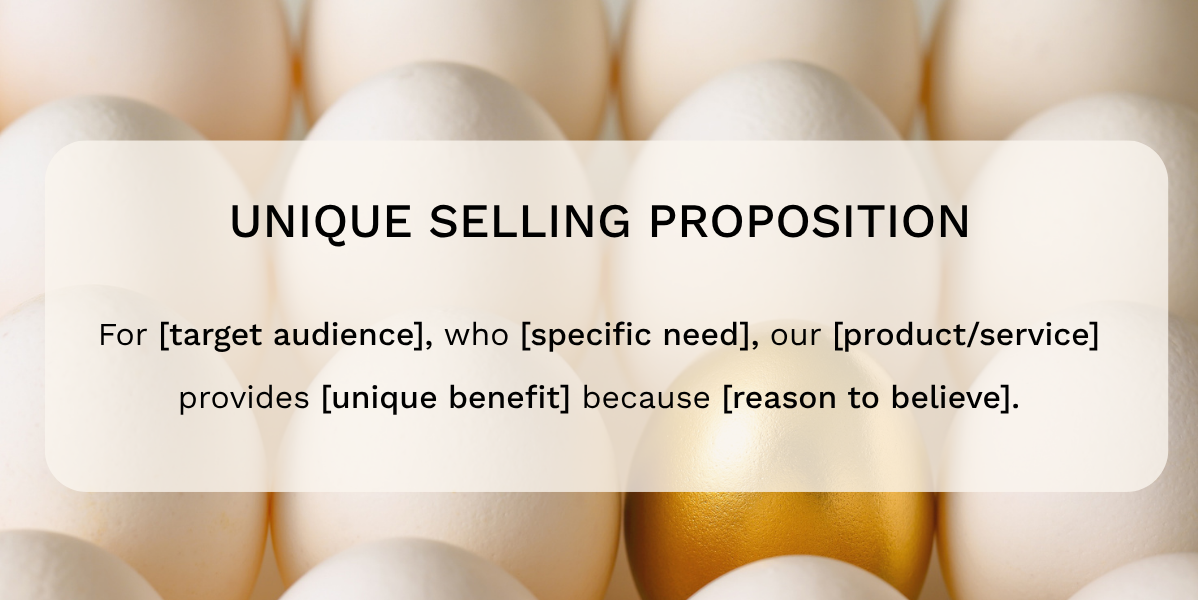
In the business world, we may refer to this as developing your “unique selling proposition” (USP). It’s the reason why people should go with you; whether that’s selecting you as their consultant, hiring you for the job, or moving you to the next round of interviews. 

“Less isn’t more” doesn’t mean write a manifesto. “Less isn’t more” means knowing the bullet points that are concise, and clear. USPs are concise, by design. 
Here’s the classic formula for a USP: 
Here's an example (related to the consulting work I do): 
  • For businesses
  • who are introducing new technologies
  • our boutique change management consultation
  • provides better data and insights so you can get people on board faster
  • because we use evidence-based practices and out training makes us experts in human motivation. 

DEVELOPING YOUR USP
Your USP will be unique to you (… hence the first word being unique!). If it sounds like every other person, you need to go deeper. Think harder about the skills in your toolbox, your unique approach, and really drill down on why you’re the person to help solve the problem. 

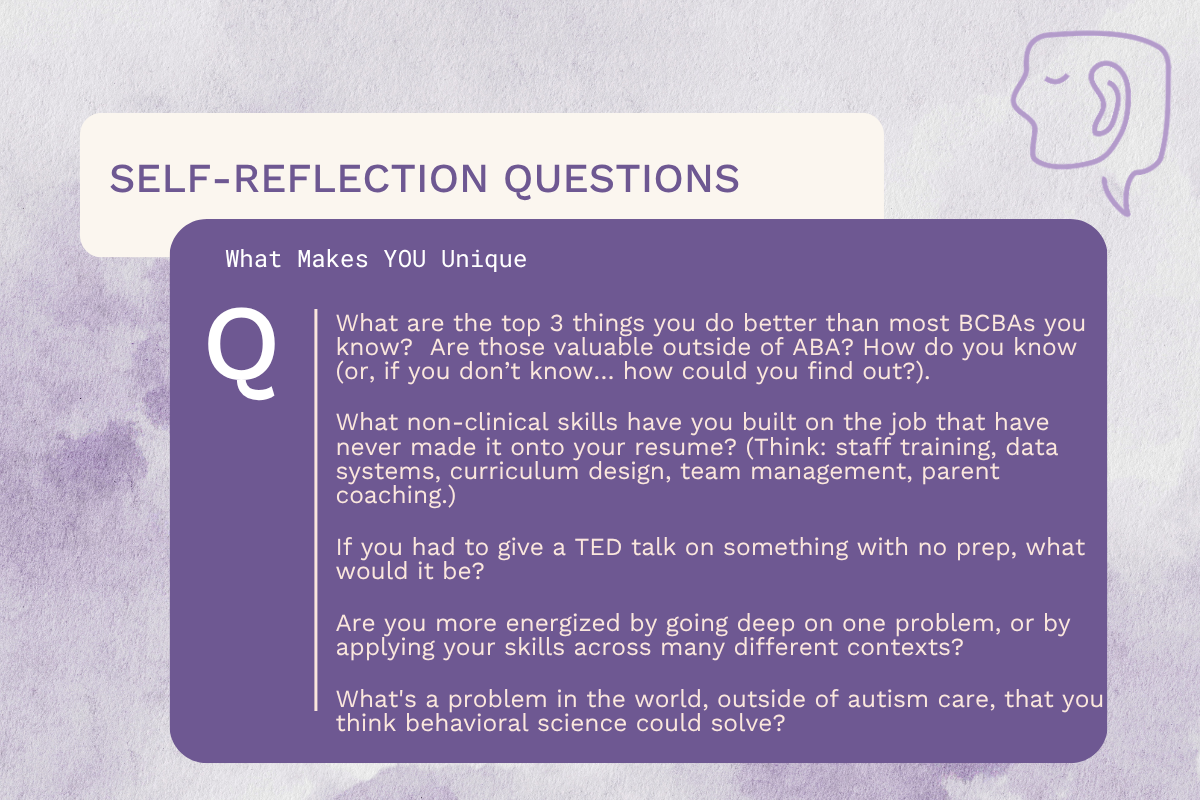
Here are some self-guided questions to help you start developing a “When less isn’t more” USP:

SELF-REFLECTION QUESTIONS

1. What are the top 3 things you do better than most BCBAs you know? Are those valuable outside of ABA? How do you know (or, if you don't know... how could you find out?). 
2. What non-clinical skills have you build on the job that have never made it onto your resume? (Think: staff training, data systems, curriculum design, team management, parent coaching). 
3. If you had to give a TED talk on something with no prep, what would it be? 
4. Are you more energized by going deep on one problem, or by applying your skills across many different contexts? 
5. What's a problem in the world, outside of autism care, that you think behavioral science could solve? 
Your BCBA credential got you in the door of this field. But in the wider job market, it's the specific skills behind those four letters that are going to open new ones. Developing your USP isn't just a networking exercise (though it will definitely help there, too). It will help you in considering your resume, answering interview questions, and in evaluating if a role gives you the opportunity to operate from a position of your strengths and values (more on the values piece here in Article 2). If you only have 3 minutes, let’s make them count! 

If you want support working through what makes you uniquely valuable, or want to connect with other BCBAs who are figuring out the same thing, check out OBM Jumpstart, or send us a note. We're here to help.