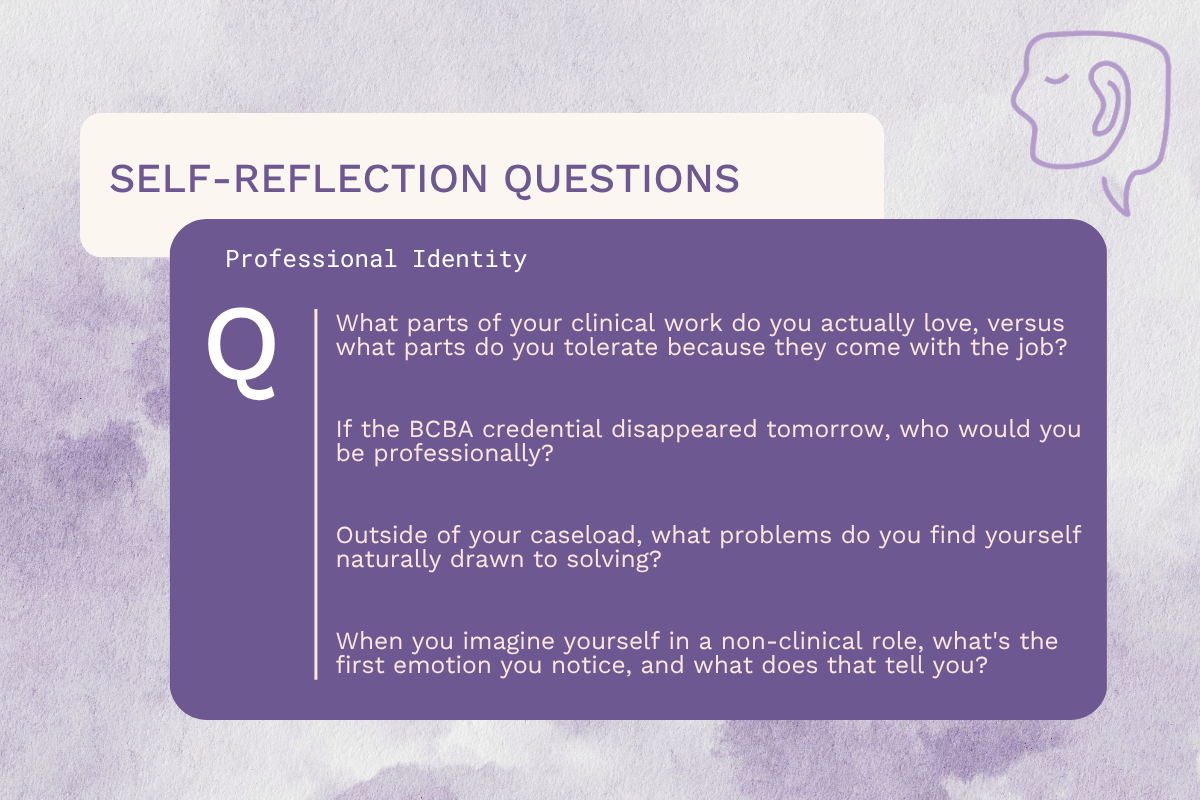
This is the first article in a 6-part series on questions to consider during your BCBA career transition.

Imagine the scene: You’re at a dinner party where you don’t know anyone. There are no dogs or cats to pet, so you have to make small talk (maybe that’s just a me thing…). You’re sipping your glass of white wine when someone introduces themselves to you and asks, “So, what do you do?”
Do you say “I work with kids with autism” and try to move the conversation along? Or do go the “I’m a BCBA. Have you ever heard of that?” route? You could go “I’m a behavioral therapist”, or maybe “behavioral scientist” is more your speed.
Answering this question doesn’t only help fill the awkward silence between hors d’oeuvres, but it may also help you understand your professional identity more clearly.
As a field, we have incredibly strong professional identities, but, as you’ll read here, they aren’t particularly flexible or resilient. When we are “stuck to” our professional identity, it can make it hard to:
So, depending on how we use them, those four letters B-C-B-A may have more impact in holding us back than propelling us forward.
-
See new opportunities
-
Communicate with non-behavioral stakeholders
-
Make sure ATS doesn’t throw our application into the digital trash
-
Convince a hiring manager why we’re the person for the job
So, depending on how we use them, those four letters B-C-B-A may have more impact in holding us back than propelling us forward.
BCBAs have deeply engrained professional identities, and for good reason. We are proud to have earned our board certified status. At minimum, we:
-
Received a master's degree
-
Completed 1,500 to 2,000 supervised fieldwork hours
-
Passed a board exam that is notoriously difficult
Some of us had to publish research, work in labs, or present at conferences. All in, it’s blood, sweat, and tears; metaphorically (and sometimes literally when it comes to blood).
Our professional identity of “BCBA” is shorthand that our field understands, but (often to our dismay) no one else does. Or, if they do they only associate it with autism work. I’ve seen behavior analysts do this over and over again. They can talk about how important it is to disseminate and communicative effectively, but when the rubber meets the road and it’s time to actually talk to people about what we do, we fall back into our deeply entrenched beliefs about ourselves and what the four letters behind our names actually mean.
In Acceptance and Commitment Training (or Acceptance and Commitment Therapy, depending on your context; aka “ACT”) we may refer to this as “fusion”. We are stuck to (aka “fused” with) those beliefs: