Write your awesome label here.
Take your knowledge of ABA into the world of zoos and aquariums, where behavior science supports better training, stronger welfare practices, and meaningful cross-species care

A NEW HABITAT
FOR BEHAVIOR SCIENCE.

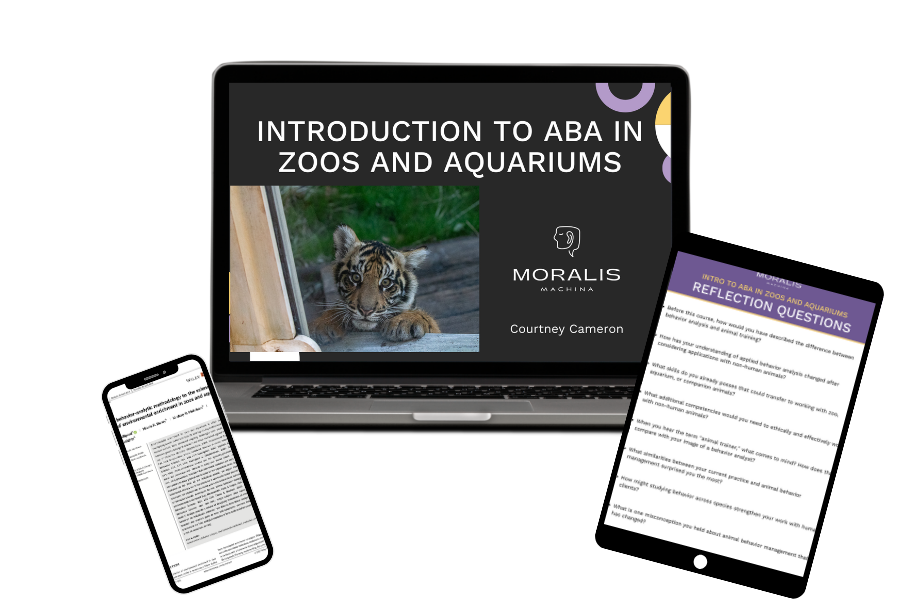
Zoos and aquariums depend on strong training, enrichment, and welfare practices to support the animals in their care. While these settings may look very different from traditional ABA environments, the same behavioral principles can be used to teach skills, define behavior, monitor progress, and improve quality of life.

In this course, you’ll learn how Applied Behavior Analysis can contribute to effective animal management across species. You’ll explore the role of operational definitions, socially significant behavior, evidence-based training, and career pathways for behavior analysts interested in zoo and aquarium work.

By the end of this course, you’ll have a clearer understanding of how ABA can support animal welfare, caregiver decision-making, and meaningful behavior change beyond traditional clinical settings.

$25

LIVE SESSION: September 24th, 2026

Pacific: 3:00 - 4:15 pm PST
Mountain: 4:00-5:15 pm MST
Central: 5:00 - 6:15 pm CST
Eastern: 6:00-7:15 pm EST

INTRO TO ABA IN ZOOS AND AQUARIUMS

SOME OF THE DISCOVERIES YOU WILL MAKE IN THIS COURSE

Connect ABA to
Animal Care

See how behavior-analytic principles support training, enrichment, welfare monitoring, and daily animal management in zoo and aquarium settings.

Explore Meaningful
Welfare Outcomes

Identify why zoo and aquarium behavior is socially significant and how ABA can support outcomes that matter for animals and caregivers.

Define Behavior
Across Species

Practice creating clear, observable definitions of animal behavior and learn why precision matters for training, care, and welfare decisions.

Discover Career
Pathways

Learn how behavior analysts can contribute to zoos, aquariums, animal training, enrichment design, welfare programs, and behavior research

EARN CONTINUING EDUCATION UNITS (CEUS) 

OP-23-10336

By completing this course you will earn:   

 
1.5 Learning CEUs 

WHY ATTEND?

HANDS ON PRACTICE

Practice identifying observable animal behaviors, writing operational definitions, and thinking through how ABA principles apply across species.

GREAT RESOURCES

Explore practical resources that help you compare behavior analysis and animal training, identify transferable skills, and consider ethical applications across species.

EXPAND YOUR PROFESSIONAL IMPACT

Discover ways behavior analysts can apply their skills beyond traditional clinical settings and contribute to animal care, welfare, and research.

Whether you’re interested in animal care, behavior analysis, or new applications of ABA, this course will help you see how familiar principles can support training, enrichment, welfare, and meaningful behavior change across species.

MEET YOUR INSTRUCTOR

Courtney Cameron, M.S.

Courtney has built her career around using behavioral science to improve outcomes for both people and animals in zoos and aquariums. Her professional experience spans animal management including training, enrichment, and welfare monitoring, in addition to professional development and career coaching for animal caregivers. She uses evidence-based strategies to create meaningful, lasting behavior change teaching the humans and animals she works with.

Through hands-on work with a variety of species, Courtney has applied positive reinforcement and behavioral principles to support animal learning, welfare, and human-animal relationships. She is passionate about demonstrating how behavior analysis extends beyond traditional clinical settings and into the world of animal behavior and welfare.

Courtney enjoys creating engaging educational content that bridges research and real-world application. She looks forward to helping learners develop practical skills while exploring the diverse opportunities available in applied animal behavior.

Kristyn Peterson, PhD, BCBA, LBA, LSSMB

Kristyn is a culture and systems-obsessed behavior analyst with experience applying behavioral science across more than 16 industries. During her doctoral studies, she also worked in a zoo with chimpanzees, giving her firsthand experience with behavior analysis in an animal care setting. She is excited to bring this perspective to the course and explore how behavioral principles can support the work of zoos and aquariums.

ABOUT US

MORALIS MACHINA

In a nutshell? 

We're behavioral scientists on a mission to make corporate culture less toxic and more top-notch. 

Come find out how to make real waves in the workplace. 

COURSE 
REVIEWS

COMING SOON

COMING SOON
COMING SOON

COURSE CONTENTS

FAQ

How many CEUs will I get?

If you're BACB certified, completing the course will get you 1.5 Learning CEUs!

Who is this course for? 

This course is for anyone curious about how behavior science can be used to improve animal care in zoo and aquarium settings. It offers an introductory look at ABA applications beyond traditional clinical environments.

Are there any pre-requisite skills? 

A basic understanding of behavioral phenomena (e.g., reinforcement, punishment and extinction) and a desire to engage is all you need for this course. 

What if I'm not certified through the BACB? 

That's okay! In lieu of CEUs, you'll get a certificate of completion.