Write your awesome label here.
Learn how behavior analysts can evaluate professional opportunities using behavioral science instead of hype to make more informed career decisions.

NOT EVERY OPPORTUNITY
IS WHAT IT SEEMS.

Behavior analysts are increasingly exposed to certifications, coaching programs, consulting offers, AI products, and “leave clinical ABA” opportunities that promise major outcomes with limited transparency. Burnout, uncertainty, and professional dissatisfaction can make these opportunities especially compelling.

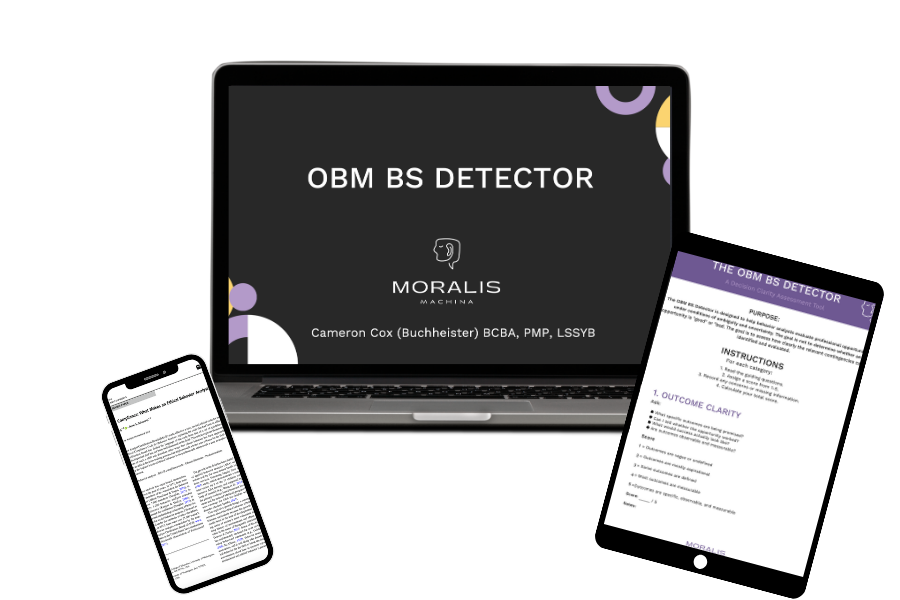
This course teaches participants how to move beyond gut feelings and evaluate opportunities using behavioral principles, observable variables, and contingency clarity. Learn how to identify risk variables, evaluate evidence, and determine whether enough information exists to make informed decisions.

Through case examples and guided activities, learners will build a practical framework for evaluating opportunities while considering ethics, reinforcement systems, and professional risk.

By the end of this course, you’ll understand how behavioral science can be used to evaluate professional opportunities, reduce ambiguity, and make clearer career decisions.

$30

LIVE SESSION: November 17th, 2026

Eastern: 6:30 - 8:15 pm EST
Central: 5:30 - 7:15 pm CST
Mountain: 4:30 - 6:15 pm MST
Pacific: 3:30 - 5:15 pm PST


OBM BS DETECTOR

Some of the discoveries you'll make in this course

Identify Behavioral
Red Flags

Recognize patterns associated with unclear contingencies, hype-based marketing, unverifiable claims, and misleading professional opportunities. 

Evaluate Professional Opportunities Ethically

Explore how ambiguity influences professional behavior and learn how ethics, scope, and contingency systems interact in decision-making.

Differentiate Promises from Outcomes

Dissect the difference between verbal claims, social proof, and measurable evidence when evaluating opportunities.

Examine Reinforcement and Risk Variables

Analyze how reinforcement structures, urgency, burnout, and uncertainty can influence professional decision-making. 

EARN CONTINUING EDUCATION UNITS (CEUS) 

OP-23-10336

By completing this course you will earn:   

 
2 Learning CEUs 

WHY ATTEND?

HANDS ON PRACTICE

Work through guided scenarios and apply the Behavioral BS Detector framework to certifications, coaching offers, consulting opportunities, AI tools, and career transition programs.

IMPROVE PROFESSIONAL DECISION MAKING

Build practical skills for evaluating claims, identifying contingencies, and determining whether enough information exists before investing time, money, or credibility.

GREAT RESOURCES

Leave with decision-making frameworks, evaluation questions, scoring tools, and strategies you can immediately apply when assessing new opportunities.

Whether you work in clinical services, leadership, consulting, or are exploring new career paths, this course introduces practical strategies for evaluating opportunities, reducing risk, and making more informed professional decisions.

MEET YOUR INSTRUCTOR

Cameron Cox

BCBA, LSSYB, PMP
Cameron began his career in applied behavior analysis in 2017 and has since worked across clinical, supervisory, and operational roles, including positions as an RBT, clinical supervisor, and Clinical Operations Director. Through these experiences, he became increasingly interested in how organizational systems, productivity expectations, and business contingencies influence both staff behavior and clinical outcomes.

Today, Cameron focuses on the intersection of Organizational Behavior Management, ethics, and professional decision-making. His work centers on understanding how reinforcement systems, organizational structures, and competing contingencies shape behavior within workplaces and professional environments.

Passionate about helping behavior analysts navigate increasingly complex professional spaces, Cameron brings a systems-level perspective to evaluating opportunities, identifying misaligned contingencies, and understanding how organizational variables influence decision-making. He looks forward to helping participants apply behavioral science to evaluate opportunities with greater clarity, confidence, and critical thinking.

COURSE REVIEWS

COMING SOON

ABOUT US

MORALIS MACHINA

In a nutshell? 

We're behavioral scientists on a mission to make corporate culture less toxic and more top-notch. 

Come find out how to make real waves in the workplace. 

COURSE CONTENTS

FAQ

How many CEUs will I get?

If you're BACB certified, completing the course will get you 2 Learning CEUs!

Who is this course for? 

This course is ideal for behavior analysts exploring new opportunities, navigating professional uncertainty, or looking for practical tools to make more informed career decisions.

Are there any pre-requisite skills? 

A basic understanding of behavioral phenomena (e.g., reinforcement, punishment and extinction) and a desire to engage is all you need for this course. 

What if I'm not certified through the BACB? 

That's okay! In lieu of CEUs, you'll get a certificate of completion.