Write your awesome label here.
Explore how leadership practices shape workplace culture, staff behavior, ethical decision-making, and sustainable care through an OBM lens.
BREAK DOWN BARRIERS.
BUILD BETTER TEAMS.
Leadership barriers are not just individual problems. They often show up in the systems around people: unclear expectations, delayed feedback, corrective-only feedback, missing reinforcement, burnout, conflict, and ethical pressure.
This course explores how those barriers affect staff behavior, workplace culture, ethical decision-making, retention, and sustainable care. We’ll examine how leaders can shape antecedents, consequences, feedback systems, and reinforcement practices to create safer, more effective organizations.
$35
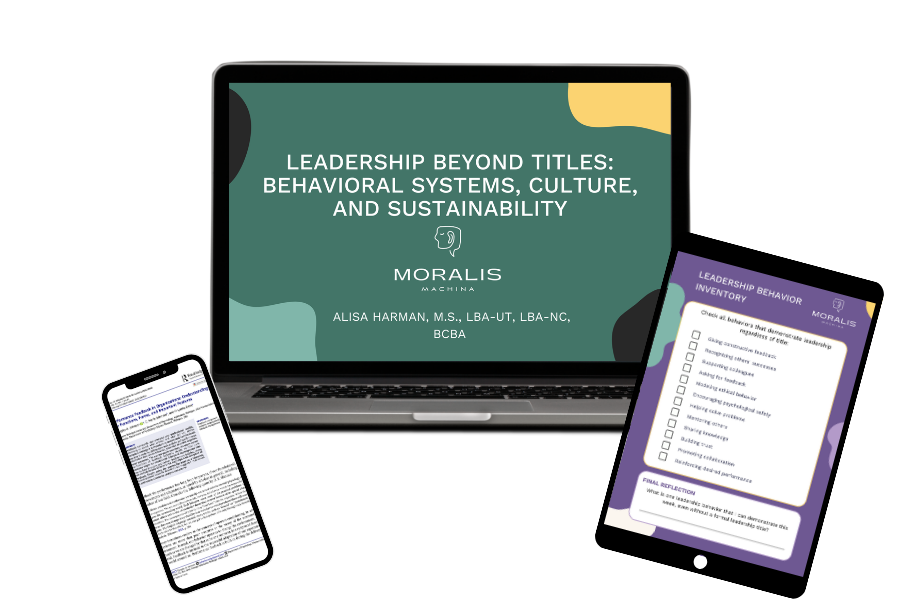
LIVE SESSION: September 9th, 2026
Pacific: 2:30 - 4:35 pm PST
Mountain: 3:30-5:35pm MST
Central: 4:30- 6:35 pm CST
Eastern: 5:30-7:35 pm EST
LEADERSHIP BEYOND TITLES
SOME OF THE DISCOVERIES YOU WILL MAKE IN THIS COURSE
Identify What Gets
in the Way
Learn how environmental contingencies can create leadership barriers that affect staff behavior, workplace culture, and service quality.
Shift From Punishment
to Reinforcement
Differentiate between punitive leadership practices and reinforcement-based approaches that support safer, more effective workplace cultures.
Analyze Feedback
Failures
Use a feedback systems framework to identify common leadership barriers, including delayed feedback, corrective-only feedback, missing reinforcement, and lack of upward feedback.
Build Psychological
Safety
Discover leadership behaviors that help create psychologically safe environments where staff are more likely to speak up, seek support, and stay engaged.
Recognize Barriers to Sustainable Care
Explore how burnout, turnover, workplace conflict, and ethical drift can weaken staff retention, decision-making, and treatment sustainability.
Strengthen Leadership Responses Under Pressure
Examine how leadership responses during conflict, burnout, ethical concerns, and process breakdowns can increase barriers or create better conditions for action.
EARN CONTINUING EDUCATION UNITS (CEUS)
WHY ATTEND?
MEET YOUR INSTRUCTOR
ABOUT US
MORALIS MACHINA
COURSE CONTENTS
FAQ
How many CEUs will I get?
If you're BACB certified, completing the course will get you 2.5 Learning CEUs!
Who is this course for?
This course is for behavior analysts, supervisors, clinical leaders, and ABA professionals who want to strengthen their leadership practices and better understand the barriers that affect teams and care.
Are there any pre-requisite skills?
A basic understanding of behavioral phenomena (e.g., reinforcement, punishment and extinction) and a desire to engage is all you need for this course.
What if I'm not certified through the BACB?
That's okay! In lieu of CEUs, you'll get a certificate of completion.