Write your awesome label here.
Understand online misinformation through the lens of behavioral systems analysis. Explore how social media platforms shape information-sharing behavior and learn to analyze digital ecosystems using behavioral science.
ONLINE MISINFORMATION ISN'T RANDOM.
IT'S SYSTEMATIC.
Online misinformation isn't simply the result of poor decision-making or a lack of critical thinking. Social media platforms operate as behavioral systems that arrange environmental contingencies, reinforce engagement, and influence how information spreads across digital communities.
In this course, you'll explore behavioral systems analysis as a framework for understanding misinformation beyond the individual. You'll examine concepts like interlocking behavioral contingencies, cultural selection, metacontingencies, and aggregate products to better understand why misinformation persists, even when accurate information is readily available.
Through real-world examples and guided activities, you'll learn how behavior analysts can analyze social media ecosystems and apply systems thinking to one of today's most complex behavioral challenges.
$90
STARTS OCTOBER 27TH, 2026
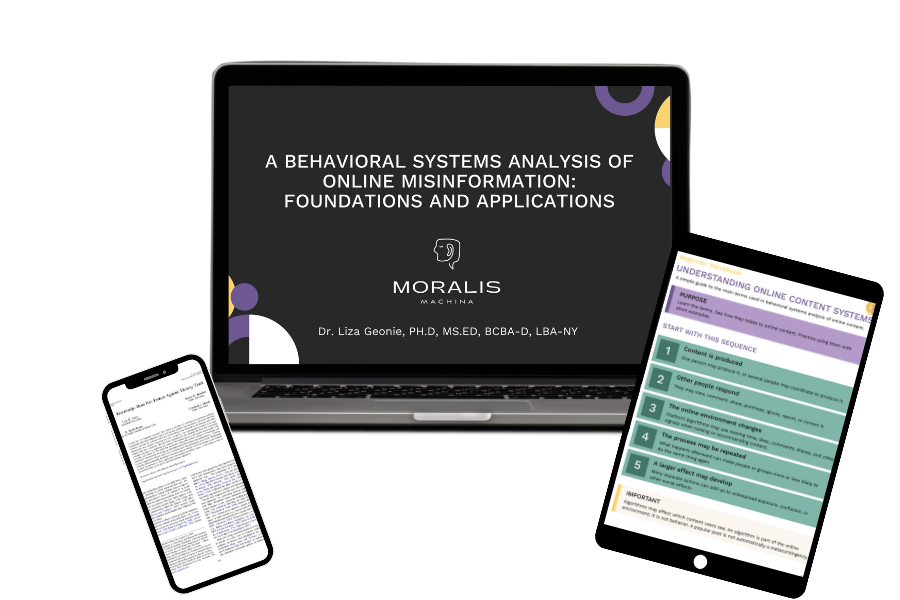
A BEHAVIORAL SYSTEMS ANALYSIS OF ONLINE MISINFORMATION: FOUNDATIONS AND APPLICATIONS
Some of the discoveries you'll make in this course
Define Behavioral Systems Concepts
Build a foundation in interlocking behavioral contingencies, aggregate products, receiving systems, metacontingencies,
and macrocontingencies.
and macrocontingencies.
Analyze Digital Ecosystems
Explore how social media platforms function
as behavioral systems that shape and maintain
information-sharing behavior.
as behavioral systems that shape and maintain
information-sharing behavior.
Apply Systems
Thinking
Practice identifying behavioral systems concepts within real-world misinformation ecosystems and online platforms.
Examine Cultural Selection
Discover how environmental contingencies, cultural selection, and digital systems interact to influence behavior at scale.
EARN CONTINUING EDUCATION UNITS (CEUS)
WHY ATTEND?
MEET YOUR INSTRUCTOR
COURSE REVIEWS
COMING SOON
ABOUT US
MORALIS MACHINA
COURSE CONTENTS
FAQ
How many CEUs will I get?
If you're BACB certified, completing the course will get you 6 CEUs!
Who is this course for?
This course is designed for behavior analysts, graduate students, researchers, educators, and professionals interested in applying behavioral science beyond traditional clinical settings. Whether you're curious about behavioral systems analysis, digital behavior, cultural selection, or the science behind online misinformation, you'll gain practical frameworks for understanding how environmental contingencies shape information-sharing behavior.
Are there any pre-requisite skills?
A basic understanding of behavioral phenomena (e.g., reinforcement, punishment and extinction) and a desire to engage is all you need for this course.
What if I'm not certified through the BACB?
That's okay! In lieu of CEUs, you'll get a certificate of completion.