Sep 15 / Dr. Kristyn Peterson, PhD, BCBA, LBA, LSSMBB

OBM CEUs for BCBAs Leaving Clinical Work | Moralis Machina

So You Want to Leave Clinical ABA. Here Is Where OBM CEUs Actually Fit.

Let's be honest about why BCBAs end up here.

Some of you are reading this because you are genuinely excited about OBM. You have been doing clinical work, you have heard about organizational applications of behavior analysis, and you want to know more. That's a great place to be.

But some of you are reading this because you are exhausted. Because clinical ABA (the version you actually work in, not the version described in textbooks) has ground you down in ways that feel embarrassing to admit out loud. The caseloads, the documentation, the management, the constant revolving door or employees, the pay that doesn't match the credential. You are not looking for a career enhancement. You are looking for a way out.

I know that second person because I was that person. I did not pivot into OBM because I had a great idea and a strategic plan. I came to it because I needed to get out, and OBM happened to be the direction that made sense given what I already knew how to do.

Both paths are valid. Both paths can lead to the same place. And OBM CEUs are one of the most practical first steps you can take from either starting point, because they let you build the skills and the credentials while you are still in your current role, before you have to make decisions with our time and money, that we can't get back. 

Here is what to actually get, why it matters, and what else you will need.


WHY OBM CEUS ARE THE RIGHT FIRST STEP

A career pivot out of clinical ABA is not just a mindset shift. It requires demonstrable competency in a new domain, a vocabulary that translates to non-ABA hiring managers, and evidence that you have done more than show up to one conference session about OBM.

CEUs give you the competency piece in a low-stakes, low-commitment way. You do not have to quit your job. You do not have to invest in a certification program before you know if OBM is the right direction. You just have to start learning, and you can do it around the job you are already doing.

The CEUs also give you something concrete to point to. In an interview, 'I've been actively building OBM skills' lands differently when you can name the specific courses, the hours, and the topics covered. It signals intent. It signals follow-through. That matters more than most people realize.

WHAT OBM CEUS YOU ACTUALLY NEED FOR A CAREER PIVOT

Not all OBM CEUs are equally useful if your goal is leaving clinical work. Here is what to prioritize.

Behavioral Systems Analysis
Performance Management
OCM
Business Skills
Ethics Beyond the Clinic
This is the foundation. BSA is how OBM practitioners diagnose performance problems at a systems level rather than an individual level. It's the framework that most clearly differentiates OBM from standard behavior analysis used in clinics, in home, and in the classroom.

If you only take one area of content before pivoting, make it this one. It is also the content most likely to come up in an interview or consulting conversation.
Most organizational roles (whether you are internal to a company or consulting externally) will require you to design or improve how performance is tracked, supported, and reinforced.

Knowing the OBM literature on performance management makes you immediately useful in a way that a clinical background alone does not. It also helps you apply concepts you already know into more industries 
Change is hard, and it is hard for reasons that are predictable, and behavioral in nature.

Understanding how to plan, communicate, and sustain organizational change is one of the most transferable skills a BCBA can develop, and one of the most in-demand in corporate settings.

Change management frameworks are often taught without any behavioral grounding. You are walking in with that grounding already. You just need the vocabulary.

This is the category most BCBAs underinvest in and most regret later.

Understanding how organizations make decisions, how to frame behavioral interventions in terms of ROI, how to scope a project, how to write a proposal.

These are not soft skills. They're the things that determine whether you get hired, whether clients renew, and whether you are taken seriously in a room that does not already know what a BCBA is.

Organizational ethics look different from clinical ethics.

Conflicts of interest, confidentiality in consulting contexts, and competing stakeholder priorities are real issues in OBM practice and worth building fluency in before you are in the room where they are happening.

WHAT CEUS ALONE WON'T DO FOR YOU

CEUs build competency. They do not build a job offer.
The other thing most BCBAs underestimate when planning a career pivot is the translation problem. Your behavioral science skills are genuinely valuable in organizational settings. The people doing the hiring often don't know that yet. Closing that gap requires more than a course certificate. It requires being able to speak about your skills in the language of the people you want to work with.

That means knowing how to write a resume that makes sense to a non-ABA hiring manager. Knowing how to talk about your work in terms of outcomes, not methodology. Knowing how to network in spaces where nobody has heard of the BACB. Knowing how to interview for roles that do not say "BCBA" in the title but would benefit enormously from having one.
These are skills you can learn! They are just different skills from the ones your graduate program covered.

What we offer for BCBAs making this transition:

The OBM Collection

$29/month

24 on-demand courses spanning BSA, performance management, change management, business skills, leadership, consulting, and more. Full library access from day one. CEUs across Ethics, Supervision, and Learning categories. Everything you need to build OBM competency on your own schedule while you are still in your current role.

The OBM Library

$39/month

Everything in the OBM Collection, plus 4-week deep-dive series (Psychological Safety, Project Management, Strategic Marketing, Process Mapping), next-day access to recorded live session CEUs, and one exclusive CEU per month. For BCBAs who are actively transitioning and want to go deeper faster.


Job Seeker Services

For BCBAs who are ready to make a move and need support with the non-CEU piece: we offer a 4-week job coaching program, resume writing workshops, resume rewrite services, and networking and interviewing workshops built specifically for BCBAs pivoting into organizational roles. These are not generic career services. They are built for the specific translation problem BCBAs face when entering the organizational job market.


WHO THIS IS FOR

If you are reading this because you are burned out and need out, we're so happy you're here and want you to know that you're not alone. 
Burnout in clinical ABA is real and well-documented, and it does not mean you chose the wrong field. It often means you have been applying a powerful skill set in an environment that doesn't work for you. And that's okay.

If you are reading this because you are genuinely excited about OBM and want to build a career in organizational settings, good news! You're also in the right place, and the path looks roughly the same from where you are standing.

What we are not a good fit for: BCBAs who want to stay in clinical work and are just looking for interesting CEUs. We have two free courses if you want to try before you commit, and we are glad to have you. But our curriculum is built for organizational application. The real skills people need to be successful, but they're less relevant for people who want to stick with managing their caseload.

If clinical is where you want to stay, Do Better Collective and Mindful Behavior do excellent work in that space and they're also just really good people. 

WONDERING WHERE TO START?

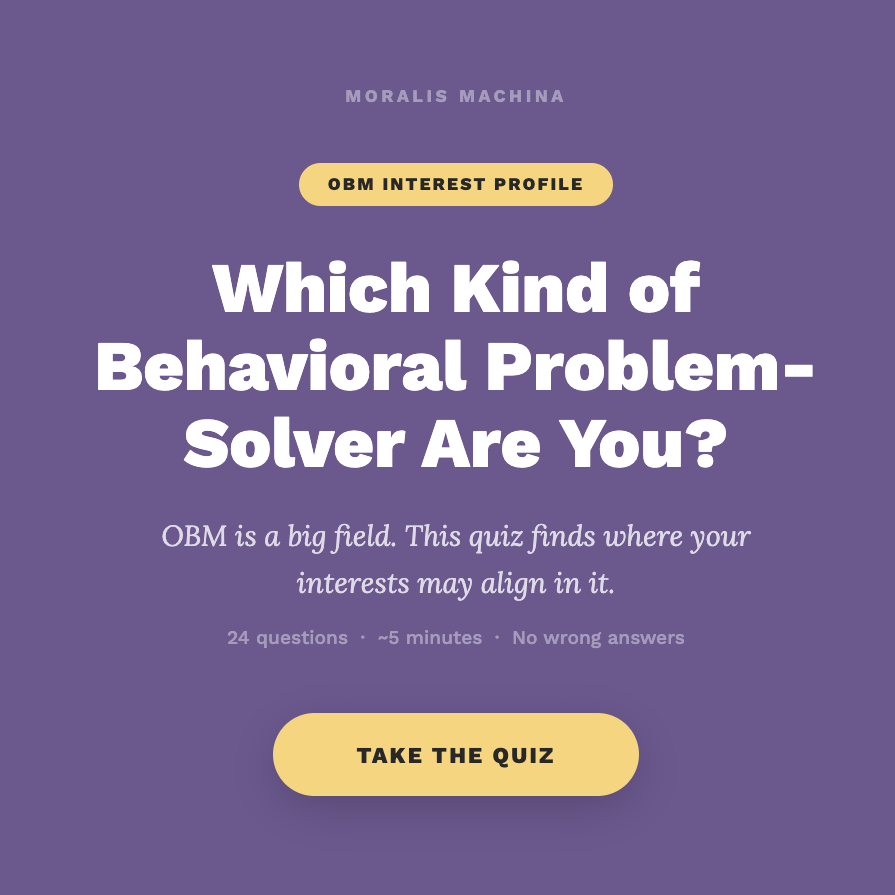
If you are not sure whether OBM is the right direction, start with our free OBM Interest Profile. It takes less than 10 minutes and helps you identify which subspecialties align with your background and interests, without committing to anything... plus, you get free access to "Intro to OBM Careers" (1.5 LRN CEUs).

If you already know OBM is where you are headed and you want to start building, the OBM Collection gives you 48 courses from day one at $29/month. Cancel anytime.

FREQUENTLY ASKED QUESTIONS

Can I transition out of clinical ABA into OBM without additional certifications?

Yes! Your BCBA credential is a legitimate foundation for OBM work. What most BCBAs need to add is OBM-specific competency (which CEUs address), the ability to communicate their skills in organizational language (which takes practice and sometimes coaching), and some form of applied experience or portfolio. Additional certifications like Lean Six Sigma or PMP can open doors, but they're usually not the starting point. 

How long does it take to transition from clinical ABA to an OBM role?

Anywhere from a few months to a couple of years, depending on how much relevant experience you already have, whether you are pivoting fully or gradually, and how actively you are building competency and network.

The single biggest accelerator is usually not the credentials; it's learning to translate your behavioral science skills into language that organizational hiring managers recognize as valuable.

Do OBM CEUs count toward my BACB renewal while I'm transitioning?

Yes, ours do! All BACB ACE-approved OBM CEUs count toward your renewal exactly like any other approved CEU.

You can build OBM competency and meet your renewal requirements at the same time, which is one of the things that makes CEUs such a practical first step for BCBAs who are still in their current roles.

I'm burned out on clinical ABA. Is OBM actually different, or is it the same problems in a different setting?

it's genuinely different, in ways that matter if burnout is what is driving you.

The payer structures are different. The population is different. The reinforcement contingencies for your own work are different. The pace and the deliverables are different.

That said, it doesn't mean OBM is without its own challenges, but the specific things that drive burnout in clinical ABA (caseload volume, documentation burden, limited autonomy, low pay relative to credential) look structurally different in organizational settings.

Most BCBAs who make the transition report that the work feels more sustainable, not because it is easier, but because the environment is better designed to support their performance and upward mobility for their career long-term. 

What is the difference between OBM CEUs from Moralis Machina and other providers?

The main difference is who built the content and why. Moralis Machina was created by a BCBA who actually left clinical work and built a career in OBM, not by someone who only studied OBM academically or teaches it adjacent to a clinical practice.

All our instructors have applied behavioral science in more than 20 industries outside of ABA settings. The content reflects that. The examples are real and built on hands-on insight. The business and consulting skills covered are the ones that actually come up when you are trying to get hired or retain clients in organizational settings.