Jul 10 / Dr. Kristyn Peterson, PhD, BCBA, LBA, LSSMBB

The BCBA Burnout Loop

BCBA's are stressed out.

ReThink Behavioral Health (2025) put some pretty sobering data to something I think a lot of us knew was true. In their survey, 89% of behavior analysts reported stress from their jobs. With more than 25% self-reporting that they were “very” stressed, or stressed had reached unmanageable levels. A similar survey found that 2 out of every 3 BCBAs had or were currently experiencing moderate to high burnout levels.

That’s great information on the “what”, but what does it tell us about the “why”?

BCBA burnout is a real problem, but it isn’t a straight forward one. Luckily, we are starting to see more research to help us uncover patterns. A few examples:
  • ReThink (2025) found that 61% of respondents reported administrative burdens and manual processes that interfered with their ability to serve clients.
  • Brown (2021) found that 77% of BCBA respondents in their survey reported supervisory pressures to act unethically
  • Plantiveau et al. (2018) as well as Slattery (2025) have found that with high burnout often comes high job dissatisfaction

Ok, so no real surprises or bombshells there. Many of us “know” this, but it is important to have peer-reviewed studies that validate what we are hearing and seeing. This article from Breaking News ABA says that 58% of BCBAs have considered leaving clinical work (though, for transparency, I couldn’t find the original source on this). Anecdotally, we talk to BCBAs who want to leave clinical work all the time. Here are some common things I’ve heard:

“I love the science but I just can’t see myself doing this work as I get older”

“I got into the field to help people, but it feels like I get to spend less and less time doing it”

“I want to do something different but I don’t know how/don’t know where to start”

“I don’t have any upward mobility/don’t see a path for myself in the future”

"I feel trapped/can't start my career over"

So, we have a bunch of stressed out BCBAs, with great skill sets who want to do more.
Where does that leave us?

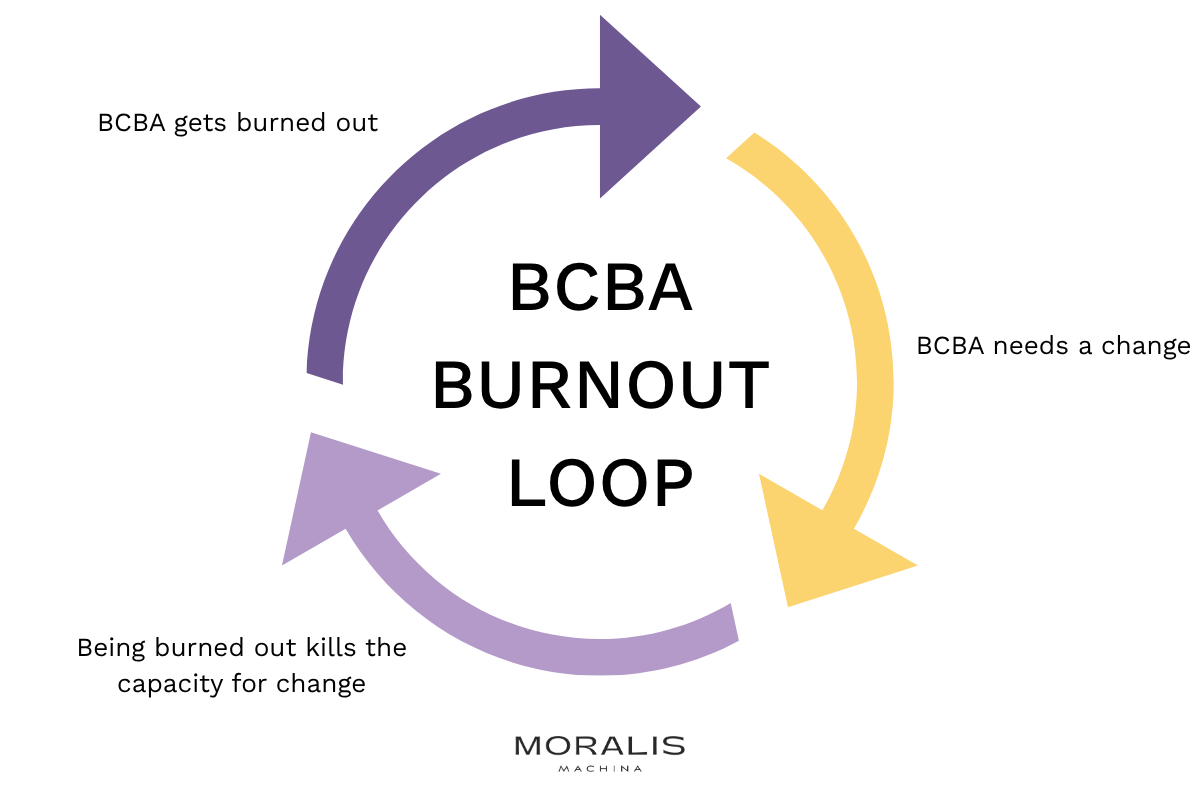
The BCBA Burnout Loop

The way I see it, there are a few outcomes that could happen here:
  • Burned out BCBAs stay in their current jobs, get more burned out and more dissatisfied. Quality care goes down. Clinicians and clients alike pay the price.
  • BCBAs job hop. “Maybe this clinic will be better than the last one”. “Maybe this pay structure will work better for me”. And maybe – just maybe – that actually works!
  • BCBAs leave the field entirely, because of the systemic issues the field seems unable or unwilling to solve.
These are terrible outcomes, for the most part.

 So, maybe there’s a different outcome. We help burned out BCBAs leverage their skills in different environment and with different populations. The Skinner Box wasn’t meant to refer to keeping BCBAs in the ASD space, after all.

BCBA career transitions out of clinical work are possible. But, when your dealing with BCBA burnout, there are additional barriers that make it tough. The funny thing about burn out is your motivation to do something different is high, but your motivation for individual tasks to actually execute the change may not be. When you’re finally home after a long day, it can feel impossible to open our laptops back up and rework that resume when a bowl of ice cream (or a glass of red wine) and some trash TV are there to help us decompress.

We try to persist under the conditions of burnout, try to unwind and recharge to show up as our best selves the next day. We put off our BCBA career transition for another day when “we have the energy” or the “timing is better”. And yet, the day never comes and the timing is never right because we can’t put out the fire from inside the house.

That's the loop: Burnout kills the capacity to change, which keeps you in the conditions that burn you out. So how can BCBAs leaving clinical work bridge the motivation for change with the low capacity to execute it?

3 Ways to Break Up the BCBA Burnout Loop

Habit Stack It | Start Small | Use Job Crafting

Start small 

Small behaviors build momentum.

  • Build out one section of your LinkedIn profile, like Skills (remembering to focus on the non-clinical skills you have). Takes just a few minutes, but in a week or two your profile will be fresh! 
  • Rewrite one job on summary on your resume. Resume updates aren’t fun. Chunk it so it doesn’t feels daunting. 
  • Read the abstract of 2 articles. 15 minutes. Low commitment. If it hooks you, you can always keep going! If not, move on. 
  • Engage in micro-learning: YouTube video, LinkedIn learning, or enroll in our totally free CEU, Intro to OBM Careers. 75 minutes, and you’ll knock out 1.5 CEUs while you do it.

Empty space, drag to resize
HABIT STACK

Add it to a routine you already have.

What are things you are already doing in your evening routine where you can insert something that helps you move forward?

  • Listen to a podcast or an audio book related to the job of your dreams and listen to it while you walk the dog, cook dinner, fold the laundry. Take 3 minutes to write down questions or insights you got afterward.

  • Use voice notes. Similar to the previous one, but one of the easiest ways to write a cover letter? Talk it out and then go edit it later.
  • Add something into your self-care routine. Self-care isn’t just bubble baths and a cup of tea (but those are really nice). Having occupational wellness and reducing stress are part of self-care, too! When we put our BCBA career transition into the bucket of “self-care” in our minds, we can pick one meaningful thing to integrate into our routines. Just shifting that mindset can help.

Empty space, drag to resize
use job crafting

Make the "have-tos" easier. 

Job crafting is strategically changing aspects of how you do your job throughout the day to make it more reinforcing, and/or to reduce aversive aspects. Even if you don’t have a ton of autonomy over your schedule or job responsibilities, you still have opportunities where you can arrange your work in a way that meets your needs.

  • Are you a momentum person, or a “get it out the way person”? If you’re a momentum person, what are some easy tasks you can mark off of your to-do list before tackling something that’s hard, or you’ve been avoiding? If “get it out of the way” is more your style, write out your to-do list and make sure to prioritize it with that in mind. 
  • A change of scenery can help. Even if when it’s assessment season and your eyes are burning from staring at your laptop, it can feel easier if you’re doing it while sipping a matcha latte at your favorite coffee shop or listening to birds from the comfort of the shade under a big tree at a park.
  • Build in reinforcement throughout your day/week. Has getting a “little treat” for a mild inconvenience become the millennial way of life? Maybe. But it can also be a powerful behavioral strategy if used well! (I rewarded myself with a mini-bottle of champagne each week if I hit my dissertation page count goal).
Empty space, drag to resize

Is this resonates, I have good news and bad news. 

The bad news: You're not alone. Lots of BCBAs feel this way. 

The good news: You're not alone. Lots of BCBAs feel this way. 
More good news? We have supports. 

Whether you’re looking for community to feel less alone, want tactical support on how to make progress toward your BCBA career transition, or want to learn new skills, we have something made just for you. 

References

Breaking News ABA Staff. (2026, April 5). The BCBA burnout crisis: 58% have considered leaving, one-third under extreme stress for two years, and 32% credentialed in the last five. Breaking News ABA. https://breakingnewsaba.com/industry-analysis/the-bcba-burnout-crisis-58-have-considered-leaving-one-third-under-extreme-stress-for-two-years-and-32-credentialed-in-the-last-five

Brown, T. J. (2021). Ethics, burnout, and reported life and job attitudes among board-certified behavior analysts. Behavior Analysis: Research and Practice, 21(4), 364–375. https://doi.org/10.1037/bar0000219

Plantiveau, C., Dounavi, K., & Virués-Ortega, J. (2018). High levels of burnout among early-career board-certified behavior analysts with low collegial support in the work environment. European Journal of Behavior Analysis, 19(2), 195–207. https://doi.org/10.1080/15021149.2018.1438339

ReThink BH. (2025). BCBA state of the profession survey: Navigating urgent challenges and shaping the future. https://get.rethinkbh.com/bcba-state-profession-survey-2025

Slattery, S. A. (2025). Exploring the relationship of burnout, job satisfaction, and leadership affinity among BCBAs in midwestern autism treatment centers: A correlational study [Doctoral dissertation, Franklin University]. OhioLINK ETD. https://etd.ohiolink.edu/acprod/odb_etd/ws/send_file/send?accession=frank1743092403310883&disposition=inline